

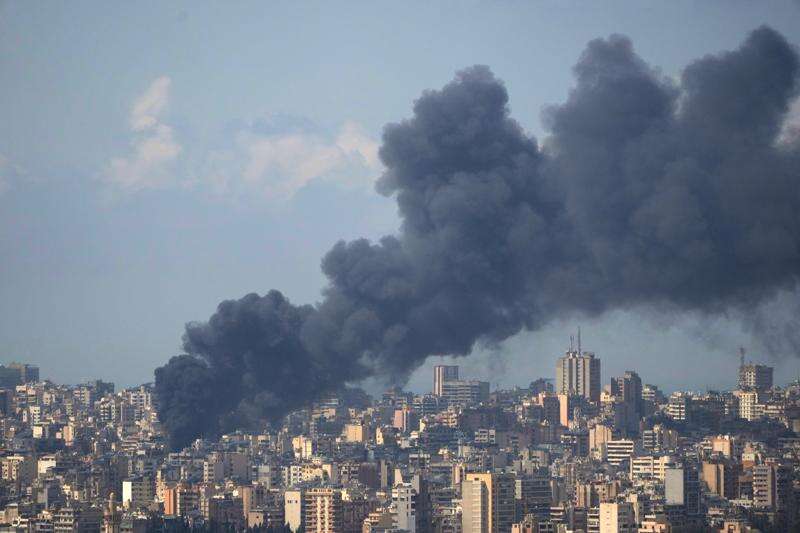
Israeli airstrikes struck crowded commercial and residential neighborhoods in central Beirut without warning on Wednesday, just hours after a ceasefire was announced in the U.S.-Israeli war with Iran. Lebanese officials said at least 182 people were killed and hundreds more were injured, marking the deadliest day in the current Israel-Hezbollah conflict.
U.S. President Donald Trump told PBS News Hour that Lebanon was not part of the agreement due to the presence of the Lebanese militant group Hezbollah. When asked about Israel’s latest attacks, he said, “That’s a separate skirmish.” Israel maintained that the deal does not apply to its conflict with the Iran-backed Hezbollah, although Iran and mediator Pakistan claimed it does.
The brief sense of relief among Lebanese citizens after news of the ceasefire quickly gave way to fear as Israel’s military launched what it described as its largest coordinated assault of the war. It reported striking more than 100 Hezbollah targets within 10 minutes across Beirut, southern Lebanon, and the eastern Bekaa Valley.
Thick black smoke rose over multiple parts of the coastal capital, where many displaced residents had sought refuge. Explosions shattered what had been a lively afternoon under clear skies. Ambulances rushed toward burning sites as flames engulfed buildings. Several apartment complexes were hit.
Associated Press journalists reported seeing burned bodies in cars and on the streets at one of Beirut’s busiest intersections in the Corniche al Mazraa area, a mixed-use district. Rescue crews used forklifts to clear smoldering rubble and searched through the wreckage for survivors.
There were no immediate signs that Hezbollah had launched retaliatory strikes against Israel in the first few hours following the attacks.
In response to the strikes on Lebanon, Iran announced later on Wednesday that it was once again suspending the movement of oil tankers through the Strait of Hormuz, according to the country’s state media.
A deadly midday barrage
Central Beirut has faced attacks before, but never with this intensity or during the middle of the day. Since the latest Israel-Hezbollah war began on March 2, Israel had seldom targeted central Beirut, instead frequently striking southern and eastern Lebanon as well as Beirut’s southern suburbs.
Lebanon’s Minister of Social Affairs, Haneen Sayed, condemned the گست reach of Israel’s strikes in an interview with The Associated Press, describing them as a “very dangerous turning point.”
“These hits are now at the heart of Beirut … Half of the sheltered (internally displaced people) are in Beirut in this area,” she said, noting that she had just passed through the affected المناطق.
She added that Lebanon’s government stands ready to begin negotiations with Israel to end the hostilities, reiterating an offer previously made by the Lebanese president. Israel has not responded. “There are calls and efforts being made as we speak,” Sayed said.
Prime Minister Nawaf Salam said in a statement that Israel was escalating at a time when Lebanese officials were attempting to negotiate a resolution. He accused Israel of striking civilian المناطق in “utter disregard for the principles of international law and international humanitarian law — principles it has, in any case, never respected.”
Lebanese President Joseph Aoun described the Israeli strikes as “barbaric.” Lebanon’s health ministry reported that, in addition to the 182 killed, at least 890 people were injured in the attacks. In total, 1,739 people have been killed and 5,873 wounded in Lebanon in just over five weeks since the war began.
Israel’s military stated that it had targeted missile launchers, command centers, and intelligence infrastructure. It claimed that Hezbollah fighters were attempting to “blend into” non-Shiite Muslim areas outside their usual strongholds.
Residents and local officials rejected those claims, insisting the targeted buildings were not military sites.
“Look at these crimes,” said Mohammed Balouza, a member of Beirut’s municipal council, speaking at the site of a strike in Corniche al Mazraa. An apartment building located behind a well-known shop selling nuts and dried fruit had been hit. “This is a residential area. There is nothing (military) here.”
An Israeli warning and a defiant Hezbollah
As smoke billowed across the city on Wednesday, Israeli Defense Minister Israel Katz warned Hezbollah leader Naim Kassem that “his turn will come.” In 2024, Israel killed Hezbollah’s former leader, Hassan Nasrallah, in an airstrike.
Katz described Wednesday’s assault as the most significant blow against Hezbollah since the September 2024 attack in which pagers used by hundreds of its members exploded nearly simultaneously.
Before the latest strikes, a Hezbollah official told the AP that the group was allowing mediators time to push for a ceasefire in Lebanon, but added, “we have not announced our adherence to the ceasefire since the Israelis are not adhering to it.” He spoke anonymously as he was not authorized to comment publicly.
The official said Hezbollah would not accept a return to the situation before March 2, when Israel carried out near-daily strikes in Lebanon despite a ceasefire technically being in place after the last full-scale Israel-Hezbollah war ended in November 2024.
“We will not accept for the Israelis to continue behaving as they did before this war with regards to attacks,” he said.
Hezbollah had launched missiles across the border days after the United States and Israel carried out strikes on Iran on Feb. 28, triggering a broader regional conflict. Israel responded with extensive airstrikes across Lebanon and a ground invasion.
Israeli military chief of staff Lt. Gen. Eyal Zamir said the operations aim to protect residents in northern Israel, who have been under sustained attack.
The Israeli military has reported killing hundreds of Hezbollah fighters, while more than 1 million people have been displaced in Lebanon.
Early Wednesday, following the announcement of the Iran ceasefire and before Israel’s strikes, many displaced families living in tents on the streets of Beirut and the coastal city of Sidon began packing to return home.
Later, families at a large displacement camp along Beirut’s waterfront voiced confusion and despair.
“We can’t take this anymore, sleeping in a tent, not showering, the uncertainty,” said 35-year-old Fadi Zaydan. He and his parents had planned to return to their home in the southern city of Nabatieh, but instead chose to remain in Sidon, closer to home, and wait.
Associated Press writer Isabel DeBre, along with AP journalists Hussein Mallah and Fadi Tawil in Beirut, Michelle Price in Washington, and Melanie Lidman in Eilat, Israel, contributed to this report.







Leave a Reply