

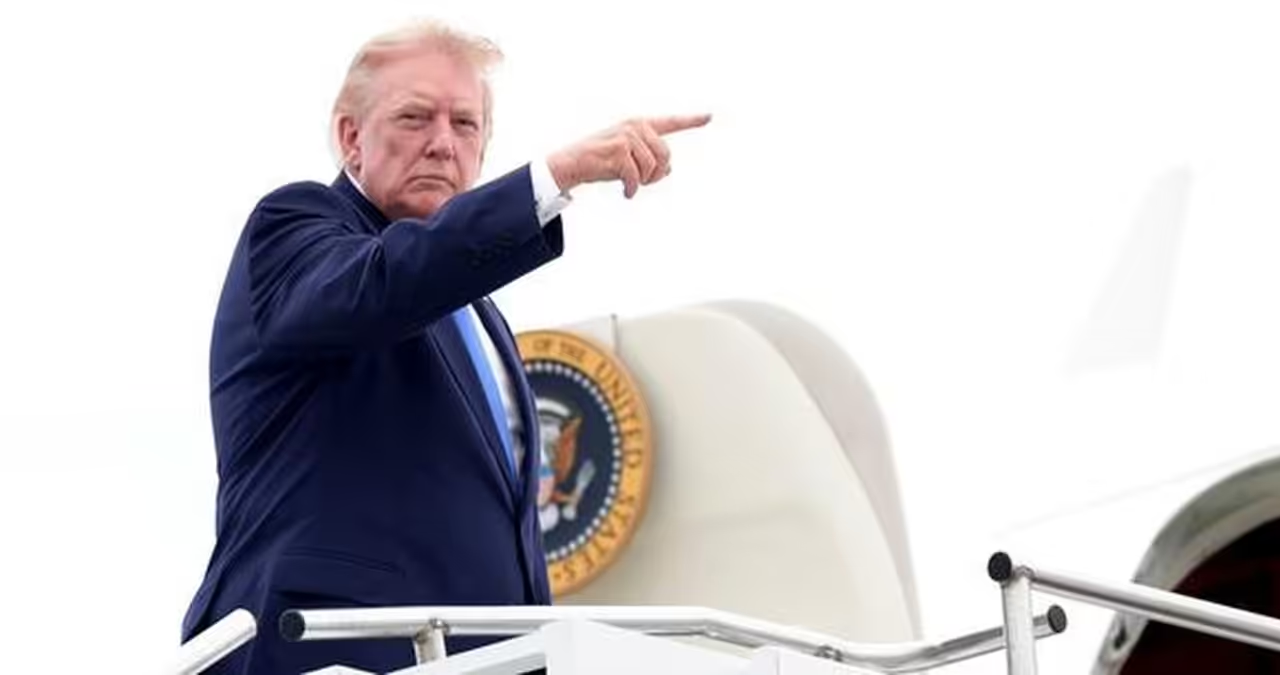
A federal judge in Massachusetts ruled Tuesday that the Trump administration broke a preliminary injunction preventing the government from carrying out President Donald Trump’s opposition to mail-in voting.
The practical effect of the decision, though, is limited and uncertain, with the judge acknowledging she “imposes no remedy other than identifying the violation.”
The decision arrives against a backdrop of disorderly court and government moves , and after the League of Women Voters asked the same federal judge to ease the pace of the case and refuse the executive branch’s “demand” for an immediate ruling.
The group’s most recent submission in the rapidly unfolding litigation acknowledged that timing mattered , but contended that urgency stemmed from the government pressing “for a major ruling on less than a day’s notice.”
The underlying dispute is straightforward: The Trump administration has long sought to carry out an executive order signed by the 45th and 47th president that would give the U.S. Postal Service (USPS) broad authority over multiple aspects of mail-in voting , and would likely penalize states that don’t comply.
The League of Women Voters and other voting rights organizations have, for now at least, won their legal challenge to block that federal takeover.
Central to the litigation is U.S. District Judge Indira Talwani, appointed by Barack Obama, who presides over two separate lawsuits connected to the USPS effort to engage in rulemaking under Trump’s order.
Over the weekend, the government notified Talwani that such rulemaking has indeed taken place and was set to take effect this week.
The voting rights group, however, promptly objected, arguing that issuing a rule breaches the injunction prohibiting the government from enforcing Trump’s order.
The government, though, didn’t act in isolation.
On Monday night, the U.S. Supreme Court stayed the injunction Talwani issued in one of the cases , a lawsuit filed by several states contesting Trump’s order.
That shadow docket ruling was not a decision on the merits and acknowledged that it “does not mean that any measure taken by the Government to implement the Order will necessarily be lawful.”
In effect, the nation’s highest court gave the government an opening to attempt implementing the executive order while appeals proceed.
Meanwhile, Talwani already appeared poised to side with the League of Women Voters in their factually related but separate case.
“Defendants did not file an appeal and did not seek, let alone obtain, a stay of the preliminary injunction,” the judge scolded on Sunday, noting that the Trump administration’s actions had disregarded “the confusion that the publication will engender.”
Late Monday night, bolstered by the conservative-majority opinion, the Trump administration filed an emergency motion asking the court to reconsider the injunction , and alternatively framed the request as a stay pending appeal. The government also filed a motion opposing the plaintiff’s attempts to enforce the injunction.
In its emergency request, the government pressed for a ruling on its motion to reconsider from Talwani by 5:30 p.m.
“Absent relief by that time, the Solicitor General of the United States has authorized the filing of a motion for a stay pending appeal with the United States Court of Appeals for the First Circuit,” the filing states.
On Tuesday morning, the League of Women Voters issued its own notice , informing the court that it would file its opposition to the government’s emergency motion by 2:30 p.m.
At roughly 2:29 p.m., the voting rights organization characterized the latest move in the fight as a government effort to intimidate the court , though one lacking substantial legal grounding.
“[T]he USPS Defendants rushed to this Court and demanded that it reconsider or stay its injunction in this case by 5:30 p.m. today, threatening an immediate trip to the First Circuit if this Court did not comply,” the opposition to the emergency motion states. “Lost in that haste are the rules of federal procedure that govern,and foreclose,the relief they seek on the timetable they demand.”
In the League of Women Voters’ view, the government is moving too hastily , and then asking the court to compound the error.
“[T]his Court lacks jurisdiction to grant the USPS Defendants’ stay pending appeal because there is no appeal currently pending,” the opposition motion continues. “USPS Defendants never appealed.”
But the government’s motion to reconsider stands on its own as a legitimate request, according to the league. The group maintains there is no need for haste simply because the USPS insists there is.
“Because the Court need not be held hostage to a demand for a major ruling on less than a day’s notice, it should consider this motion in conjunction with Plaintiffs’ forthcoming supplemental complaint and motion for a temporary restraining order,” the opposition motion adds.
Talwani issued her ruling promptly regardless.
Less than an hour after the League of Women Voters filed, the court delivered the ruling the government had requested.
In her opinion, the judge stated that the government’s arguments “ignore the court’s explicit directive not to ‘initiat[e] or complet[e]’ rulemaking.”
“Defendants cannot contend that they misunderstood the scope of the court’s order,” the five-page memorandum and order reads.
From the order at length:
To the contrary, Defendants feigned complete compliance with the California v. Trump injunction in their July 27, 2026 request to the Supreme Court for an emergency stay in that case. There, Defendants lamented the passing of “every day that the agencies are unable to take steps to carry out the Executive Order as to the November 2026 election.”
“The Supreme Court accepted the government’s feigned compliance,” Talwani noted in a footnote.
While Talwani acknowledged there was little she could do at this stage given that the rule was issued in contravention of the injunction, she offered the League of Women Voters a sense of probable next steps in the case.
“Defendants’ violation of the court’s order may ultimately inure to Plaintiffs’ benefit, where, now that a Final Rule has issued despite the pendency of the injunction, Plaintiffs could choose to file an amended complaint reasserting their current … claims, but noting that the issuance of a Final Rule is no longer hypothetical,” the order reads.









Leave a Reply