

WASHINGTON (AP) — President Donald Trump’s administration said Thursday it is suspending Microsoft and several other firms from a program that lets foreign workers apply for green cards. The administration also lashed out at universities that bring international students to the U.S. on exchange programs.
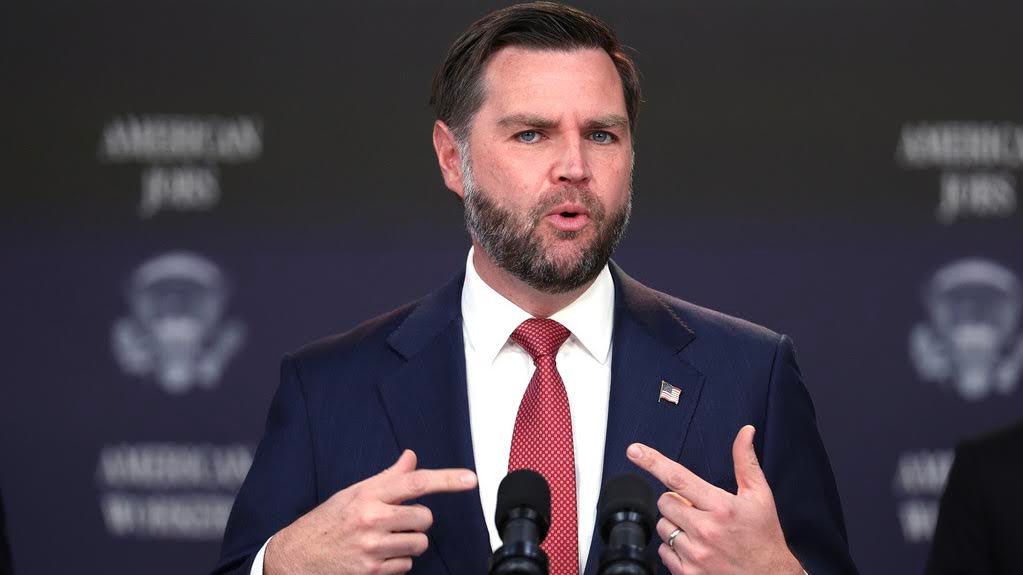
Vice President JD Vance announced the moves, the latest swing by the Trump administration at employers and universities that welcome foreign students and workers into the country.
Some Trump supporters have frequently targeted such programs, arguing they undercut American students and workers. Backers of the programs say they allow the U.S. to attract the best talent from around the world and fill important hiring gaps.
Supporters of the Republican president have long argued that programs like H-1B visas essentially let American companies recruit foreign workers for jobs that end up undercutting Americans. Vance accused Microsoft of abusing that program. In the wide-ranging announcement, he and other top administration officials also called out universities over their use of J-1 visas for international students, along with information technology outsourcing firms.
The announcement came hours before Trump was scheduled to award the National Medal of Technology and Innovation to Microsoft CEO Satya Nadella. The ceremony is part of an event where Trump is granting some of the nation’s most prestigious science and technology awards to his tech billionaire allies.
Vance says US workers are replaced with ‘foreign indentured servants’
Vance said the program from which Microsoft is being suspended requires companies to advertise jobs in America before applying to the Department of Labor to show they need to give a foreign worker a green card because of a lack of American workers.
“They’ll put an advertisement in a small-town newspaper. They’ll go out there and say that ‘We have advertised for a position with our company, and nobody is responding to it.’ And they will use that lack of response to then go and replace American workers with what is effectively foreign indentured servants,” Vance said. “There has been no company in the United States, unfortunately, that has used this system more than Microsoft.”
U.S. Citizenship and Immigration Services data shows Microsoft ranks No. 5 among U.S. employers in H-1B visa use. Amazon holds the top spot.
Microsoft, based in Redmond, Washington, said it looks forward to “providing the Administration with additional information.” The company said 80% of the roughly 6,000 H-1B applications it filed last fiscal year were “to extend or change the status of existing Microsoft employees.”
“These were not to hire new people,” Microsoft said in a statement. “The remaining filings for new employees were for individuals already legally in the United States who decided to come work for us, and they equal only 1% of our U.S. workforce. They are not new arrivals to our country.”
The company added that it files H-1B petitions only for “those who meet the rigorous standards of this visa category.”
Doug Rand, a former senior adviser at USCIS during the Biden administration, called Vance’s announcement “incoherent.”
“If the Trump administration were truly concerned that H-1B workers are ‘indentured servants,’ then the last thing they would do is block companies from helping their own H-1B workers get green cards,” he said. “Once you have a green card, you’re no longer dependent on your employer for your immigration status — you’re a permanent resident who can change jobs and negotiate higher wages without fear.”
Vance said Microsoft laid off 6,000 American workers last year but also obtained 6,300 H-1B visas and almost 3,000 green cards.
“If you do the math, for every worker that Microsoft laid off, they replaced that worker with one and a half foreign indentured servants,” Vance said in a White House news conference announcing the decision. “Our message to Microsoft is: You’re a great American company, but you’ve got to hire great American workers.”
Vance said H-1B workers are effectively foreign indentured servants because they must leave the country if they lose their jobs, and they earn less than Americans in the same position.
H-1B program has been scrutinized
Trump supporters have long targeted the H-1B program, saying it undercuts American workers and is rife with abuse.
H-1B visas are meant for high-skilled jobs that employers struggle to fill with American workers. Technology companies use them most, and nearly three-quarters of approvals go to workers from India.
Last year, Trump tried to raise the fee for H-1B work visas to $100,000, saying it would protect American workers from losing their jobs to lower-paid foreigners. A federal judge struck that down in June.
The administration has since tried a different approach, announcing plans in August for a $103,265 fee. The proposed regulation described the new fee as a “dedicated revenue mechanism to help recover a portion of the federal government’s costs of administering the lawful immigration system.” The rule isn’t final yet, and like the earlier fee, it is expected to face a legal challenge.
Ron Hira, a Howard University political science professor and longtime critic of the H-1B program, called the move against Microsoft “very significant.” Hira noted that the White House issued a little-noticed executive order last month directing government agencies to “implement appropriate measures to protect American workers from abuse of the H-1B program and ensure that the program serves the national interest.”
“There are supposed to be protections for U.S. workers that say: If you hire an H-1B, you are promising that you are not adversely affecting similarly employed U.S. workers,” Hira said. “That’s never been enforced.”
Besides Microsoft, Vance said the government is similarly suspending Adobe and the tech consulting firms Cognizant, Infosys, Tata, Wipro, HCL and Capgemini. The companies did not immediately respond to messages seeking comment.
Trump also has targeted foreign students
The Vance announcement came a day after Trump’s administration launched another broadside against international students and their ability to work in the U.S.
On Wednesday, the Department of Homeland Security proposed a $70,000 fee for international students seeking to work in the United States. The proposed rule would require schools to pay the fee for every student who participates in the Optional Practical Training program, known as OPT. The program lets students work in jobs related to their major during or after their time in school.
Vance also called out universities, suggesting they were abusing a program that brings international students to the U.S. These temporary visas, called J-1 visas, let international visitors come to the U.S. for work and study exchange programs. In most cases, students must get the majority of their funding from an institution, such as a fellowship-granting organization, rather than paying tuition personally.
Vance singled out nine universities that he said merit further investigation for J-1 visa fraud, saying they used the program in greater proportions than their counterparts.
The universities were Harvard; Yale; Stanford; Brown; the University of Pittsburgh; the University of California, Davis; the California Institute of Technology, or Caltech; Arizona State; and the Massachusetts Institute of Technology, or MIT. Stanford said it would cooperate with the investigation. The other universities did not immediately respond to requests for comment.









Leave a Reply