

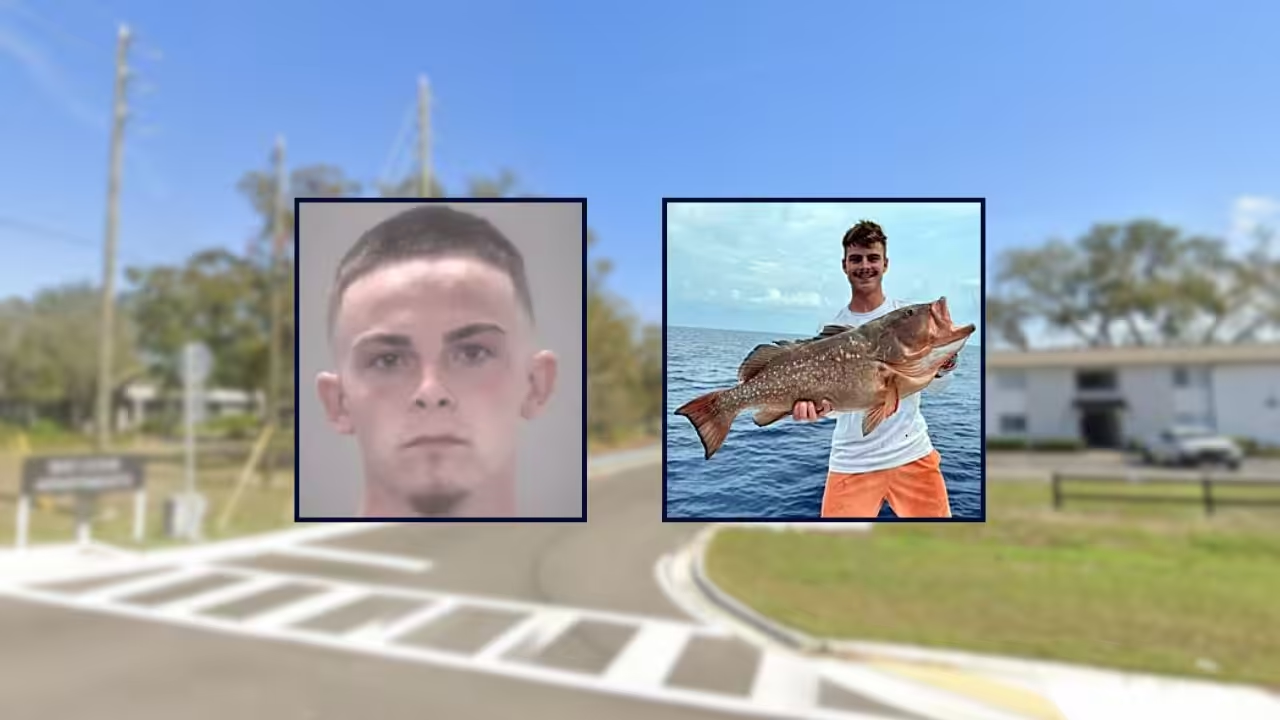
A Florida man will spend several decades behind bars after shooting and killing his ex‑girlfriend’s lover in a late‑night altercation.
In July, 25‑year‑old Stuart Beck was found guilty by a Pinellas County jury on one count of second‑degree murder for the July 2022 death of 20‑year‑old Michael Conrad. This week, Sixth Judicial Circuit Judge Philippe Matthey sentenced Beck to 30 years in prison.
### The Incident at Bay Cove Apartments
The violence unfolded in the early hours of July 6, 2022, at the Bay Cove Apartments on 19135 U.S. Highway 19 North in Clearwater,about 20 miles west of Tampa. During a confrontation whose exact details were hotly disputed by both the state and the defense, Beck shot and killed Conrad. While Beck never denied pulling the trigger, his account of why he did so shifted dramatically over the years, a change noted in a Tampa Bay Times courtroom report.
### Beck’s Defense Narrative
From his arrest through the trial, Beck claimed the shooting was accidental. Yet on the stand he told prosecutors the discharge was intentional,just not intended to kill.
> “I didn’t mean to kill him, but I meant for the gun to go off,” the defendant reportedly told the jury.
Beck maintained that he acted in self‑defense after being beaten by Conrad and two of Conrad’s friends. He described feeling “in fear for my life” during a final bedroom struggle.
> “We were basically wrestling for the gun and moving around the general area,” he testified. “I had tried to raise my hand to get him to let go, and at that time he had his other hand on the gun, and I started losing grip, and I tried to hit him with the gun to get him to let go, and he didn’t let go. I felt it was in my best interest to shoot him at that time otherwise he would get the gun.”
### Prosecution’s Counterargument
The state challenged Beck’s self‑defense claim by highlighting Beck’s actions before the shooting, starting with him kicking down the apartment door.
> “You cannot break down a door, break into an apartment, point a gun at someone who has nothing on him,” a prosecutor argued. “That’s not self‑defense, members of the jury, that’s murder. You don’t get so close to somebody and put a pistol up against their chest as an accident.”
### Motive and Relationship Context
The underlying motive appeared tied to Beck’s anger over his ex‑girlfriend’s new relationship. The woman at the center of the dispute testified that she and Beck had broken up months before the shooting, though Beck’s name remained on the lease and she still saw him occasionally while dating Conrad.
> “This is a heat‑of‑passion shooting; this is a love triangle,” defense attorney Scott Tremblay said. “This is a manslaughter case at best.”
Beck asserted he didn’t know Conrad was present when he entered the apartment. However, prosecutors presented testimony that Beck had called the woman earlier that night, saying he saw Conrad’s truck parked outside, indicating he knew the lover was there.
### Jury Verdict and Sentencing
The jury largely accepted the state’s narrative, finding Beck guilty of second‑degree murder but rejecting a first‑degree charge because they concluded the killing was not pre‑meditated. During the sentencing hearing, one of Conrad’s aunts described the lasting pain Beck’s actions caused.
> “You didn’t just kill him; you killed laughter in our home,” she said. “You killed quiet moments that should have been filled with his voice. You condemned us to a lifetime of grief, and I hope you carry that same burden.”
### Conclusion
Stuart Beck’s case underscores how personal turmoil can spiral into tragic violence, and how juries weigh self‑defense claims against the facts of a night that turned deadly. With a 30‑year prison term, Beck will now serve a lengthy sentence for a decision that forever altered the lives of those left behind.


Leave a Reply