

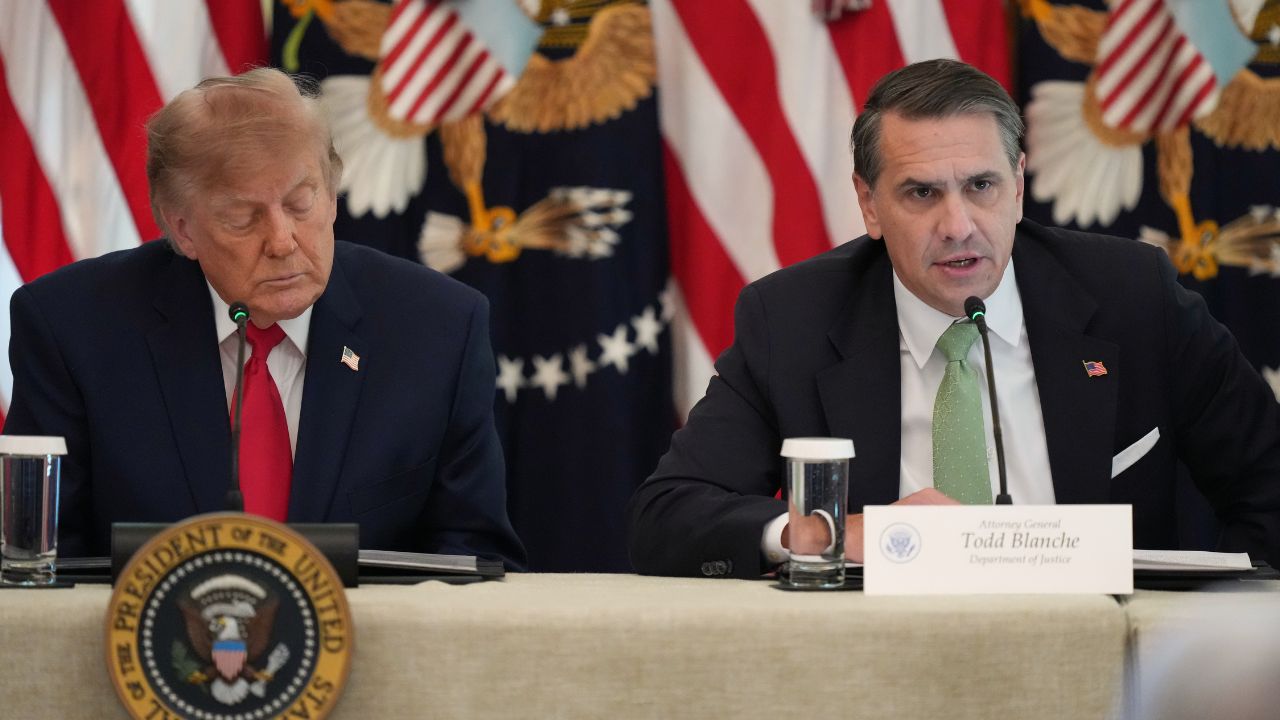
The Trump administration secured a significant legal victory on Thursday after a federal court determined that U.S. Attorney General Todd Blanche would not be required to submit to a deposition in a civil lawsuit filed by alleged victims of Jeffrey Epstein.
In September 2024, a group of women claiming to have been sexually abused by Epstein filed a formal complaint against the U.S. government pursuant to the Federal Tort Claims Act (FTCA), a statute that permits individuals to seek financial compensation from the federal government. The plaintiffs, collectively identified as Jane Does, allege that federal agencies , including the FBI and the U.S. Department of Justice , failed to appropriately investigate or respond to the Epstein scandal across multiple prior administrations.
The Trump administration, consistent with its sustained resistance to Epstein-related legal proceedings, sought to have the lawsuit dismissed. That effort was unsuccessful. In September, U.S. District Judge David S. Leibowitz, appointed by President Joe Biden, authorized a 90-day period of limited discovery, which included inquiry into the specific FBI rules and protocols governing the handling of child sexual abuse tips.
In early October, the plaintiffs moved to subpoena Attorney General Blanche, requesting “any and all documents pertaining to Jeffrey Epstein,” along with a proposed deposition date scheduled for later that month.
The Department of Justice responded by characterizing the subpoena as “extraordinary” and filed a motion to quash, arguing that compliance would “threaten the separation of powers, chill agency decision making, discourage public service, and create potential for abuse or harassment.” The government simultaneously sought a protective order to shield Blanche from being compelled to provide the requested testimony.
U.S. Magistrate Judge Ryon M. McCabe, assigned to the matter by Judge Leibowitz, ultimately ruled in favor of the government.
The court began its analysis by acknowledging a procedural limitation: under the Federal Rules of Civil Procedure, the motion to quash could not technically be granted, as the presiding judge is located in southern Florida while the subpoena pertained to compliance within the jurisdiction of New York City.
“A federal court in Florida cannot quash a subpoena that calls for compliance to take place in New York,” the eight-page order states.
However, the ruling on the motion to quash was largely procedural in nature. The substantive outcome was determined by the court’s decision to grant the protective order, supported by two distinct legal grounds.
“[T]he Court finds that the Government has shown good cause for entry of a protective order,” Judge McCabe wrote. “First, Plaintiffs’ duces tecum request for ‘any and all documents pertaining to Jeffrey Epstein’ goes far beyond the limited jurisdictional discovery permitted by the District Judge.”
The court further noted that Judge Leibowitz had previously confined discovery to two narrow issues: FBI rules and protocols pertaining to child abuse reporting, and the question of whether the Jane Does had exhausted their administrative remedies.
“The duces tecum request goes far afield of these topics,” McCabe concluded.
The court additionally ruled in the government’s favor on the basis of the “apex doctrine” , a principle rooted in the separation of powers that is designed to protect “high-ranking government officials from judicial subpoenas for testimony except in rare circumstances.”
“To overcome the apex doctrine, the record must show ‘extraordinary circumstances’ or ‘special needs’ for compelling the appearance of a high-ranking officer in a judicial proceeding,” the judge wrote. “Of significance here, the doctrine cannot be overcome where a claimant can obtain the desired testimony or information from alternative sources.”
In practical terms, the court determined that Attorney General Blanche was neither the sole nor the most appropriate source for the information being sought.
“Here, Plaintiffs are still in the midst of the limited jurisdictional discovery allowed by the District Judge,” the court explained. “They have not yet received responses to their written discovery, nor have they deposed the Government’s Rule 30(b)(6) witness(es). The Court has taken steps to expedite the outstanding discovery and will continue to do so to ensure Plaintiffs get the discovery they are due.”
While McCabe’s order represents a meaningful victory for the government, it is not an unconditional one.
The judge noted that during a July meeting with several Epstein victims , including a number of the current plaintiffs , Blanche “purportedly” stated, “you got screwed over by the FBI, but I cannot fix the FBI’s lack of investigation.” In light of that remark, the court determined that Blanche would be required to respond to a limited set of questions, though he would be permitted to do so in written form rather than through an in-person deposition.
“In the Court’s view, these comments implicate matters potentially within the scope of the limited jurisdictional discovery allowed by the District Judge,” the order states. “As such, the Court will allow Plaintiffs to propound up to ten (10) interrogatories, pursuant to Rule 33, to be answered by Attorney General Blanche in his official capacity as an employee of the United States.”
The court specified that the “scope” of those interrogatories must be confined “to the comments allegedly made by Attorney General Blanche” during the July meeting. The government was given 15 business days to submit its written responses.






Leave a Reply