

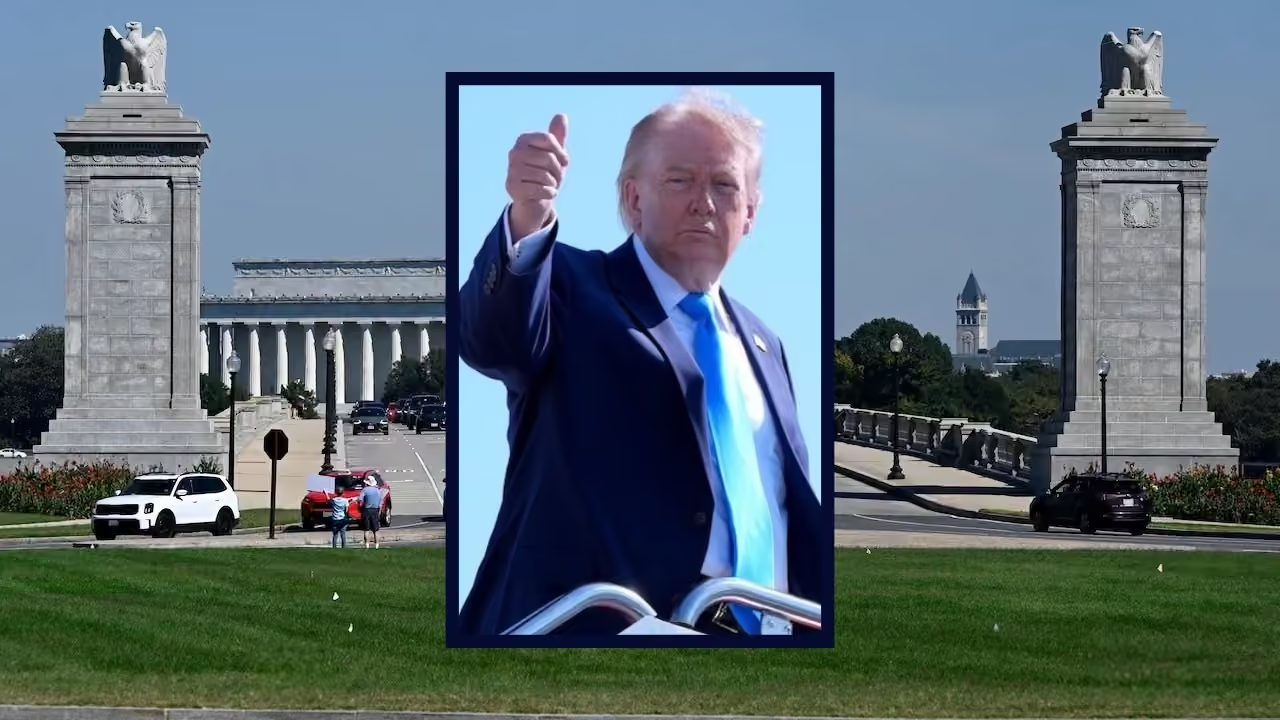
For months, the Trump administration’s Department of Justice and the federal judge overseeing multiple lawsuits concerning the president’s proposed “Great Triumphal Arch” have been engaged in an ongoing legal confrontation over her efforts to prevent the project from becoming an irreversible reality. That standoff reached a decisive point late Thursday, when U.S. District Judge Tanya Chutkan issued a temporary restraining order blocking the administration from proceeding with construction.
Judge Chutkan , who previously presided over President Donald Trump’s January 6 prosecution , determined that the Department of the Interior had “issued its final decision […] approving construction” and, on that basis, ruled that plaintiffs from Washington, D.C., and Virginia were entitled to immediate judicial relief.
“[T]he harm is certain,” Chutkan wrote.
The Obama-appointed jurist was already aware of the National Capital Planning Commission’s (NCPC) lengthy hearing on Thursday, which ultimately concluded with the commission’s approval of the arch.
Prior to the NCPC meeting, Chutkan had directed the government to inform her of any decision within one hour of its issuance. Following the commission’s vote, she delivered a pointed rebuke of the administration’s last-minute legal arguments and national security justifications.
In her memorandum opinion, Chutkan expressed deep skepticism that Congress had authorized the construction of a 250-foot arch at Memorial Circle more than a century ago without any prior administration ever recognizing or acting upon such authority.
“The sheer improbability that a 100-year-old statute would contain authority, unknown to every previous administration, to erect a 250-foot arch at a principal location in the Nation’s capital indicates how far Defendants must stretch to justify this project,” the judge said. “Indeed, they materialized, for the first time, when Defendants filed their opposition brief last week.”
Judge Chutkan was equally unconvinced by eleventh-hour assertions concerning presidential security and national defense advantages, which Defense Secretary Pete Hegseth put forward in a sworn declaration.
“[T]hese recent and unsupported attestations of security aspects of a structure that has been extensively discussed over the last year appear nowhere in the planning documents on which the project was reviewed and approved,” Chutkan observed.
Hegseth’s declaration characterized the arch as a “generational national defense opportunity” that would serve to “defend the Homeland” against drones and “evolving threats.”
Vietnam War veterans have also voiced their opposition to the proposed “top grade Military Complex/Triumphal Arch” at Memorial Circle , a structure the president described as one that would “house, store, and have the rapid ability to use large numbers of drones, plus Snipers” directly across from Arlington National Cemetery.
In dismissing the government’s assertion that the court’s intervention would cause it harm, Chutkan underscored that the administration “cannot suffer harm from an injunction that merely ends an unlawful practice,” and further concluded that “[t]here is generally no public interest in the perpetuation of unlawful agency action.”





Leave a Reply