

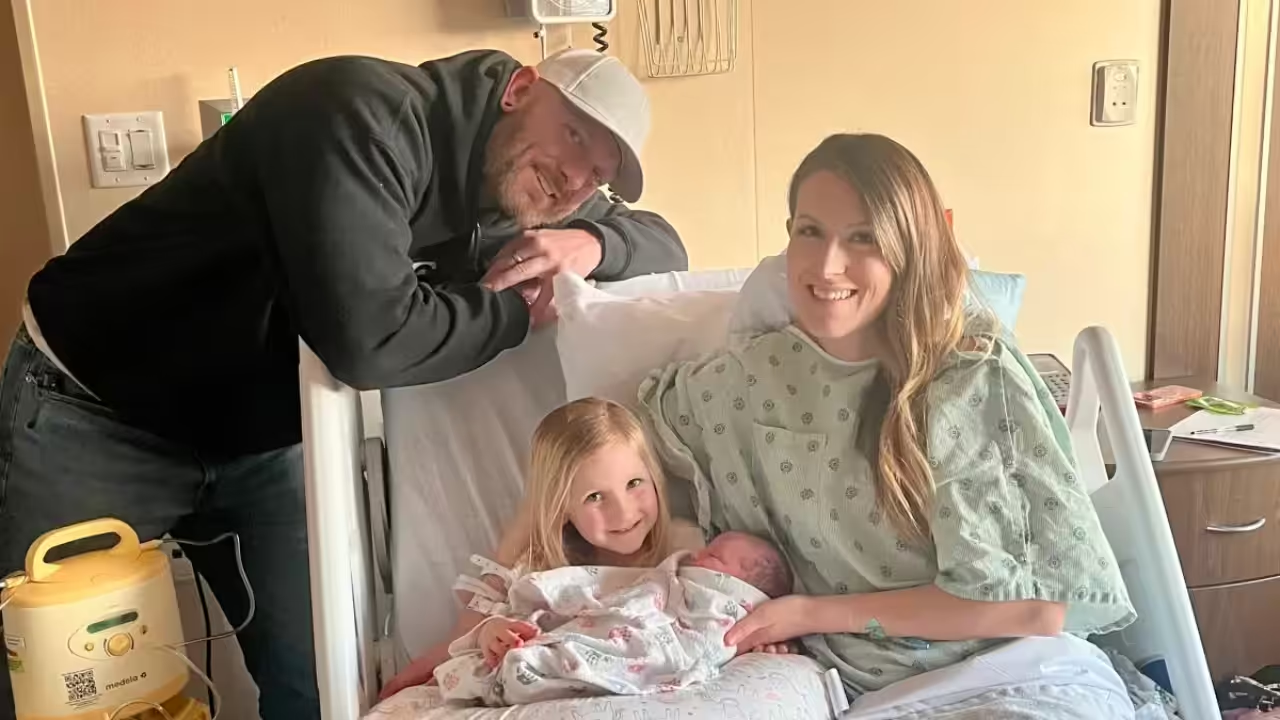
Lisa Fasone desperately wanted to give her daughter a little brother or sister. But when she and her boyfriend, Larry Brastad, began trying, they found themselves among the millions of Americans struggling with infertility.
“I thought I was never going to have another child,” the 32-year-old McHenry, Ill., woman told People. “It was an awful feeling.”
More than a year later, doctors found a solution — but reaching it meant going deep inside Fasone’s brain.
After welcoming her first child in 2022, Fasone began noticing symptoms she chalked up to shifting postpartum hormones — night sweats, headaches, fatigue, and an absent menstrual cycle. She also continued producing milk long after she stopped nursing.
“I kind of chalked it up to I just had a baby, you know, a year or two ago,” said Fasone, a urology physician assistant in the Chicago area. “I’m just still not quite right because of that.”
When doctors ran bloodwork, they discovered her prolactin levels were elevated. The pituitary gland — tucked at the base of the skull — produces this hormone, which drives lactation and plays a role in fertility.
“They suspected it was a tumor because I didn’t have any other risk factors for why my prolactin would be so high,” Fasone said.
Medication brought her levels down for a time, but she eventually stopped responding to the drugs and her symptoms came back. She also grew concerned about what the treatment could be doing to her body.
“The medication isn’t well studied for pregnancy,” she said. “I just didn’t feel comfortable trying to have a baby without good data to suggest it was safe.”
It left her caught in a Catch-22: getting pregnant meant stopping the medication immediately to protect her baby, but going off it risked letting the tumor grow and triggering further complications.
The benign mass, known as a prolactinoma, is the most common type of pituitary gland tumor.

In the US, roughly 1 in 10,000 people will develop one, according to the Pituitary Society. The cause remains unknown, though women are far more likely to develop one than men.
While the tumor posed no threat to her life, it was making pregnancy nearly impossible by suppressing her estrogen and testosterone — two hormones essential for reproduction.
“Taking her tumor out is like taking an orange seed out of a blueberry and not trying to mess up the blueberry … that’s how small it is.” —–Dr. Stephen Magill
“The pituitary gland is the master hormone regulator of our body,” said Dr. Stephen Magill, a neurosurgeon with Northwestern Medicine. “When you get tumors in the pituitary gland, they can disrupt some of that hormonal regulation.
“In [Fasone’s] case, it was a very small tumor, but it was having a big effect on the body because it was secreting and elevating these prolactin levels.”
Prolactinomas can typically be managed with medication. But Fasone was dealing with a wave of side effects from the drugs, and her goal of getting pregnant made an already complicated situation even harder to navigate.
“I had to make a decision,” Fasone said. “Do I continue increasing the dosage of this medication that’s not making me feel great and doesn’t seem to be working, or am I going to face the issue and have it surgically addressed?”
In the end, she said yes to the operation.
On April 14 of last year, she placed herself in Magill’s care as he and Northwestern Medicine otolaryngologist Dr. Kevin Welch removed the tumor, reaching her brain through her nose.
“Taking her tumor out is like taking an orange seed out of a blueberry and not trying to mess up the blueberry,” Magill said. “It’s just that’s how small it is, what we’re doing and trying not to miss anything.”
Fasone spent about a month off her feet recovering from the operation — but it would prove worth every day.
“Thirty days after my surgery, my menstrual cycles restarted and I had not had a normal period since well before I got pregnant with my first child because of this problem,” Fasone said. “So that was really exciting.”
A few weeks later, bloodwork showed her prolactin levels had climbed again.
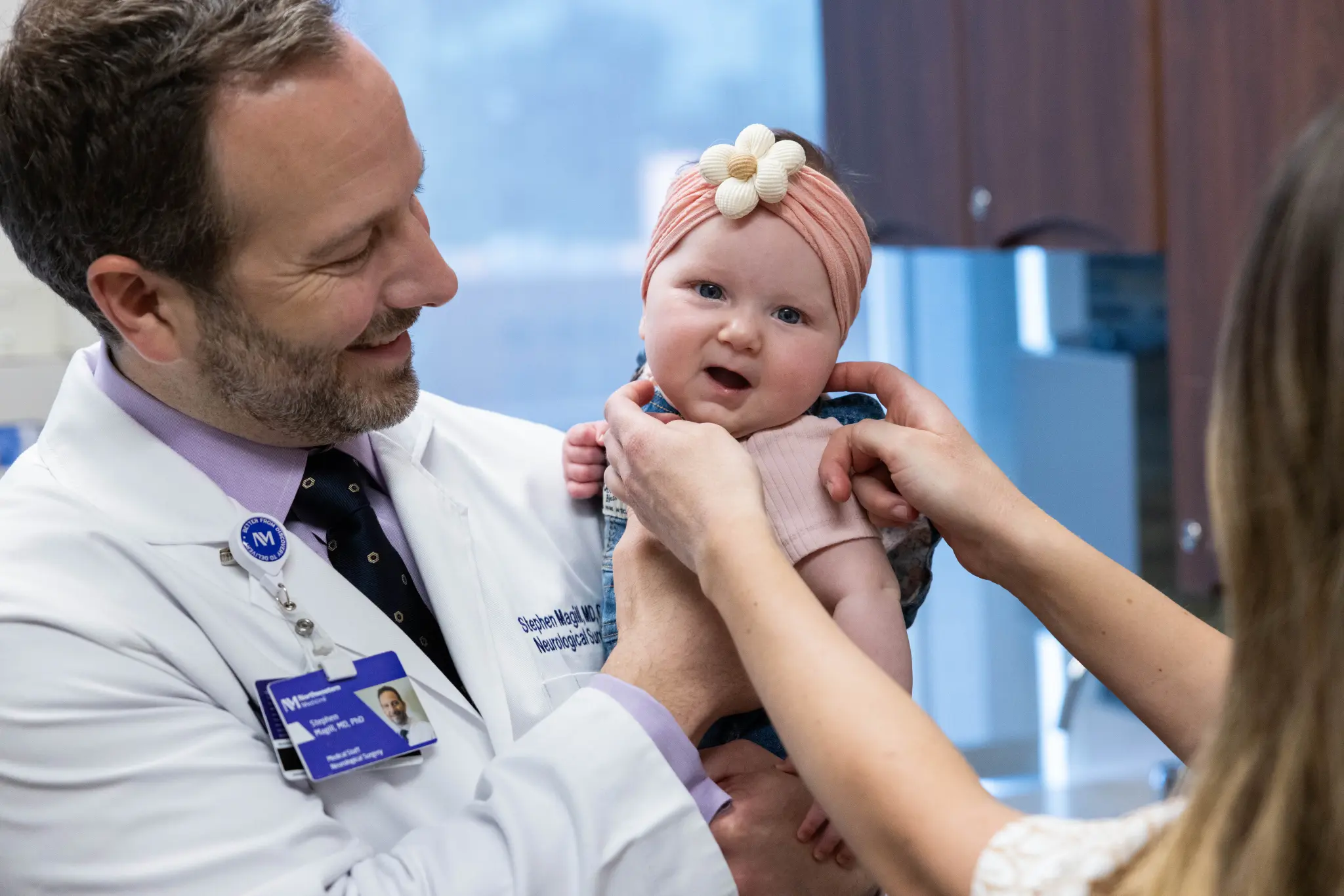
Fason gave birth to her second child, Natalie, in February.
“I was like, oh my gosh, here we go. Same problem. He didn’t get all the tumor,” Fasone said. “But it turns out that my prolactin levels were elevated because I was actually pregnant.”
Fasone gave birth to a daughter, Natalie, in February. Recently, they made a trip to visit Magill so he could meet the little girl he helped bring into the world.
“The reason we all went into medicine, and I did at the beginning, is to really help people,” he said. “Holding a healthy baby is just — it’s incredible.”
Fasone credits Magill with turning her life around.
“I was able to get off the medication, my body returned to normal, and I was able to complete my family,” she said, calling the moment she introduced Natalie to Magill one she’ll never forget.
Across the globe, one in six people struggle with infertility — and yet, Fasone said, it remains a “very isolating” experience despite how widespread it is.
“I think being a woman of childbearing age, it can be really difficult to go through that process, especially when your friends are getting pregnant,” Fasone said.
She urged others navigating infertility to seek out support groups and to push back when doctors dismiss their concerns.
“If you feel like something’s wrong, make sure that your voice is heard,” Fasone said.



Leave a Reply