

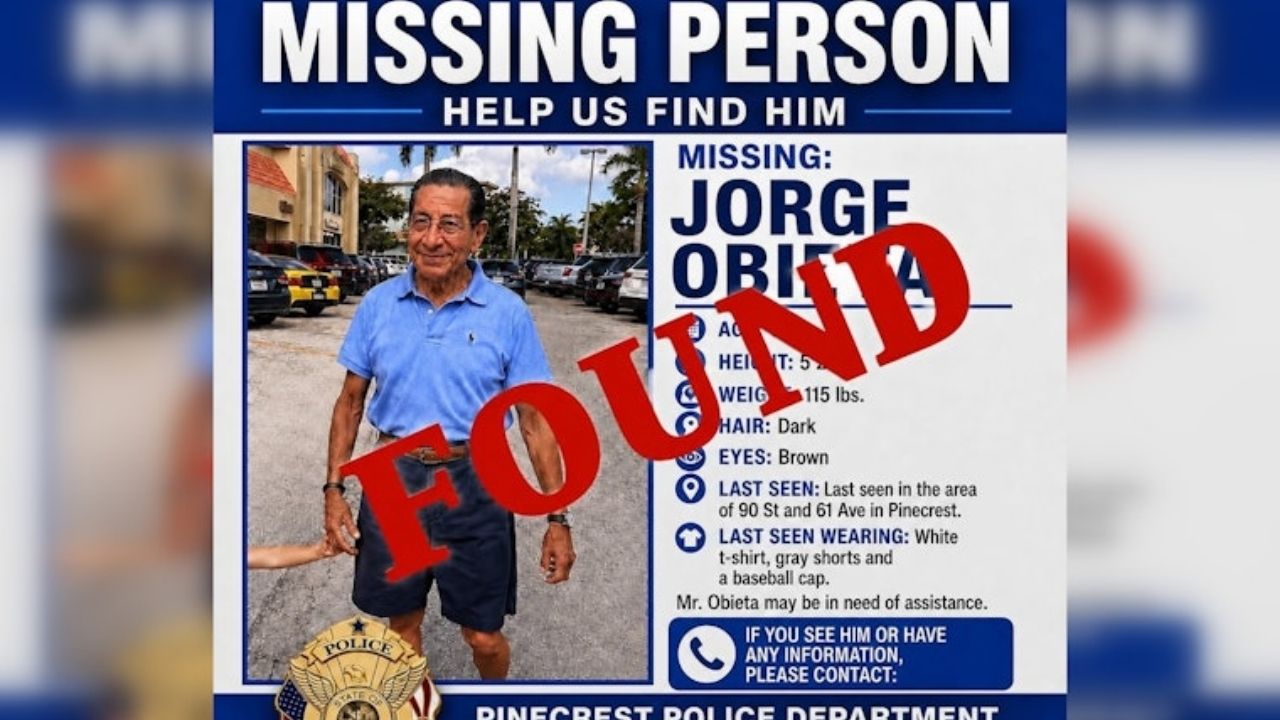
A 75-year-old Pinecrest man who was reported missing was discovered safe on Tuesday, according to police. Jorge Obieta was reported missing from the upscale Miami-Dade village before cops found him uninjured later that day.
According to the Pinecrest Police Department, Obieta was discovered safe on Tuesday, as first reported by WSVN. The station’s report did not say where Obieta was discovered or how long he was missing until officers found him.
According to current reports, police have not publicly stated whether Obieta was enrolled in any special needs registry or if a Silver Alert was formally issued in connection with his abduction. These specifics remain unknown, and no other information concerning his disappearance has been disclosed.
Cases involving missing older individuals are especially urgent in Florida, which has one of the highest numbers of seniors living with cognitive deterioration in the country. According to the Florida Department of Health, approximately 573,806 Floridians aged 65 and over, or about 11.3% of the state’s senior population, are likely to have Alzheimer’s disease. According to research cited by UF Health Jacksonville, about six out of ten patients with dementia will wander at least once, a tendency that can lead to significant harm or disorientation if not discovered soon.
That possibility is one of the reasons why Florida law requires police to meet rigorous timeframes when a senior is deemed vulnerable. According to Online Sunshine, under Chapter 937 of the Florida Statutes, authorities investigating a missing endangered individual must put their information into the Florida Crime Information Center database within two hours of establishing they are endangered, resulting in a BOLO report. Missing adults with cognitive disabilities are classified as endangered according to state law.
According to the Florida Department of Law Enforcement, in order for an alert to be activated, a missing person must be at least 60 years old — or between 18 and 59 without legal capacity — and law enforcement must verify an irreversible cognitive impairment such as Alzheimer’s or dementia. The program was first established by presidential order in 2008 and then codified into state statute. When a missing senior is believed to be in a vehicle, FDLE guidelines require state Silver Alerts to activate dynamic highway messaging signs operated by the Florida Department of Transportation, which display vehicle descriptions and license plate numbers for up to six hours to solicit tips from drivers.
Separately, Florida’s Protect Our Loved Ones Act, which went into effect on January 1, 2024, allows local law enforcement agencies to maintain voluntary, confidential databases of residents with cognitive disabilities, such as Alzheimer’s and dementia, to aid in emergency disappearances, according to News4JAX. Under the law, caregivers or individuals can voluntarily provide local police departments with emergency contact information and behavioral features ahead of time.
Pinecrest, an affluent village of approximately 18,400 residents in Miami-Dade County, with a significantly older demographic profile than much of the surrounding area. According to U.S. Census Bureau predictions, residents aged 65 and over will account for around 17.5% of the village’s total population by 2025, implying that almost a fifth of Pinecrest’s population is reaching an age where cognitive problems become more widespread.
The Pinecrest Police Department, commanded by Chief Jason Cohen since his appointment in July 2021, patrols a 7.54-square-mile area and works 24/7 from the Pinecrest Municipal Center on US 1, according to the Village of Pinecrest. Cohen is the department’s fourth police chief and the first to advance from its internal ranks. Aside from conventional patrol tasks, the department has a Criminal Investigations Section and a Community Resource Team, and also participates in the Blue Envelope Program, a public safety effort that helps residents with communication issues during police encounters.
State officials have also allocated large funds to assist families caring for elderly with memory disorders. According to the Florida Department of Elder Affairs, the Alzheimer’s Disease Initiative will receive $73.8 million in December 2025, as well as $126.5 million in community and home care services for vulnerable older persons. That cash is meant to help prevent out-of-home placement and provide respite to caregivers around the state.




Leave a Reply