

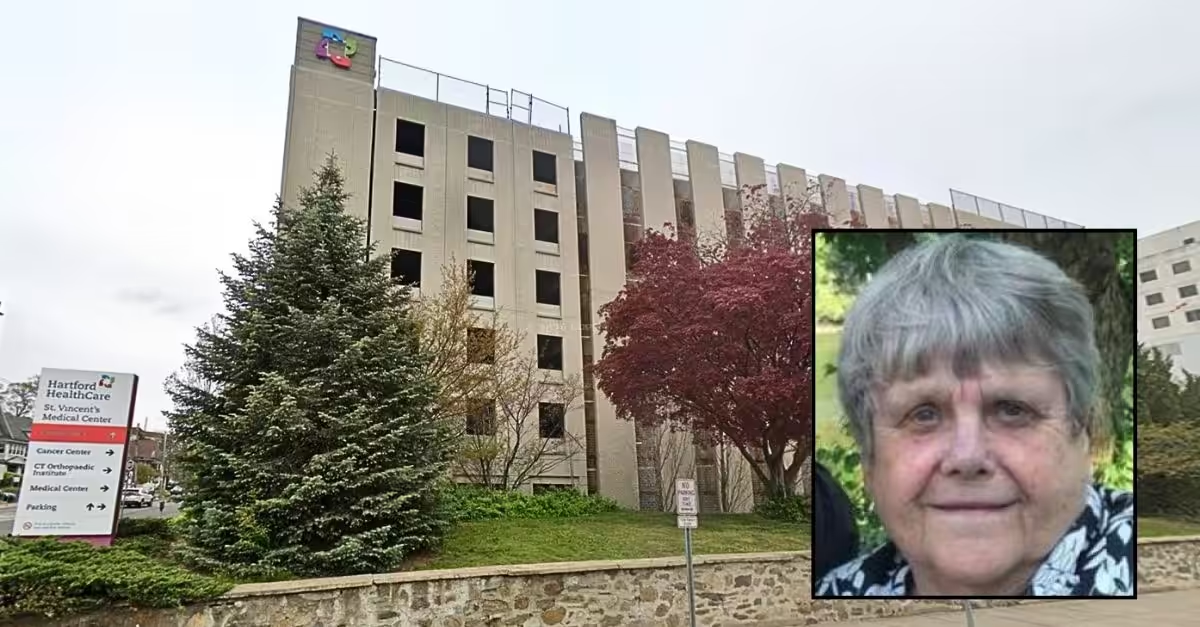
An 80-year-old Connecticut grandmother died after hospital staff allegedly ignored her postoperative dietary restrictions and served her regular meals instead of the prescribed “liquid diet” and “easy to chew” food, according to a lawsuit.
Shelton native Carol Polifka, who had lung cancer, underwent a “robotic-assisted” right lower lobe wedge resection surgery with mediastinal lymph node sampling and bronchoscopy at St. Vincent’s Medical Center on Jan. 23, 2024. Her family said the procedure was successful and doctors completed it without complications.
However, the lawsuit filed this month by her son claims mistakes during Polifka’s recovery ultimately led to her death.
“Nursing staff departed from the standard of care … by serving, and documenting as received, a ‘regular’ diet on at least two separate shifts, in direct violation of the active SLP-ordered dysphagia level 7/mildly thick liquid diet and in the absence of any physician order upgrading the diet to regular,” the complaint states, citing an opinion letter from a licensed registered nurse with more than 25 years of experience who reviewed the case.
“It is my opinion to a reasonable degree of nursing certainty and professional probability that there is evidence of medical negligence on the part of the nursing staff,” the letter states, according to the complaint.
After the surgery, doctors ordered Polifka to follow a diet consisting of “easy to chew” foods and “mildly thick liquids,” which a Speech-Language Pathologist (SLP) implemented on Jan. 27, 2024. According to the complaint, the SLP required a “modified-consistency” diet along with “specific aspiration precautions.”
The complaint states that “Decedent’s medical history and clinical condition placed her at known and elevated risk for aspiration, including but not limited to: age 80; moderate-to-severe chronic obstructive pulmonary disease with chronic CO2 retention; recent postoperative state; post-anesthetic hypercapnic encephalopathy with documented BiPAP use on postoperative day zero and postoperative day one; morbid obesity; documented postoperative cognitive fluctuation; and altered mentation.”
According to the lawsuit, before the SLP consultation took place on Jan. 27, 2024, nurses unexpectedly advanced Polifka’s diet to “clear liquids” and later to a “cardiac (solid consistency) diet at lunch” on Jan. 23, 2024. The complaint alleges staff made those changes without conducting a bedside dysphagia screening or requesting an SLP consultation.
When the SLP eventually conducted a “bedside clinical swallow evaluation” along with a Fiberoptic Endoscopic Evaluation of Swallowing (FEES) on Jan. 27, 2024, the examination allegedly “confirmed pharyngeal dysphagia with airway compromise to thin liquids” and identified a “high likelihood of aspiration along posterior tracheal wall with thin liquids,” according to the complaint.
The findings indicated that Polifka allegedly struggled with swallowing and faced a heightened risk of food becoming lodged in her mouth or throat, potentially causing choking or allowing food and liquid to enter her lungs — commonly referred to as going “down the wrong pipe.”
The SLP formally ordered a diet consisting of “dysphagia level 7 solids (easy to chew) and mildly thick liquids,” along with “1:1 supervision” and precautions such as “small bolus size, slow rate of intake, upright positioning, monitoring for cough or change in vocal quality, cessation of eating at signs of fatigue, and oral care,” according to the complaint.
Despite those instructions, the lawsuit alleges nurses served Polifka a “regular” diet on Jan. 29, 2024, while failing to “inspect, verify, and confirm that each meal tray delivered to [Polifka’s] bedside matched the active diet order.”
The complaint also accuses the nursing staff of failing to “implement and enforce” the ordered aspiration precautions, including “1:1 supervision at meals, small bolus size, slow rate of intake, upright positioning during and after eating, and monitoring for cough or change in vocal quality.”
“No physician order upgrading her to regular diet was entered,” the complaint states.
On the morning of Jan. 30, 2024, a respiratory therapist allegedly attempted naso-tracheal suctioning and documented “copious amounts” of vomiting by Polifka “into her airway.”
Later that same day, Polifka reportedly suffered a “second vomiting event,” according to the complaint. The document says she developed “worsening hypoxic and hypercapnic respiratory failure, went into PEA cardiac arrest, and was pronounced dead.”
“Respiratory culture grew E. coli, an enteric organism diagnostic of aspirated gastric contents,” the nurse’s opinion letter states. “The ICU admitting physician’s note recorded the admission diagnosis as ‘acute on chronic hypercapnic respiratory failure secondary to aspiration pneumonia.’”
According to the complaint, the Connecticut Medical Examiner determined Polifka’s cause of death to be “infectious complications of right lung wedge resection with lymph node dissection for treatment of adenocarcinoma of the lung” and classified the manner of death as “therapeutic complications.”
Attorney Patrick Filan, who represents Polifka’s family, told the Hartford Courant that the greatest tragedy was that “she had a good outcome” from the surgery. Her lesion was later reclassified as “adenosquamous carcinoma,” and the “margins were negative,” meaning doctors removed the lung tissue with a border of healthy tissue and found no remaining cancer cells along the edges.
“It’s not a case where the operation went wrong, it is basic postoperative attention to detail where she was let down,” Filan said. “Elderly [patients] are very reliant on hospital staff. Sadly, they let her down.”
A spokesperson for Hartford HealthCare, which operates St. Vincent’s Medical Center, told the Courant, “Our heartfelt thoughts and deepest sympathies are with the family at this time. We are unable to provide further comment on pending litigation.”








Leave a Reply