

Ohio residents pay property taxes based on a fraction of their home’s value, yet ballot language presents the full property value.
In Ohio, property taxes rely on the assessed value, which equals 35% of a property’s market value. However, ballot language for tax requests often refers to the full market value rather than the 35% assessment. While this wording does not affect how much residents actually pay, it has caused confusion among voters, some of whom contacted NBC4 for clarification. See previous coverage of property taxes in the video player above.
When voters review ballot language for local levies, they are reading wording largely determined by the state. Ohio law requires bond issues and levy requests to follow specific language guidelines.
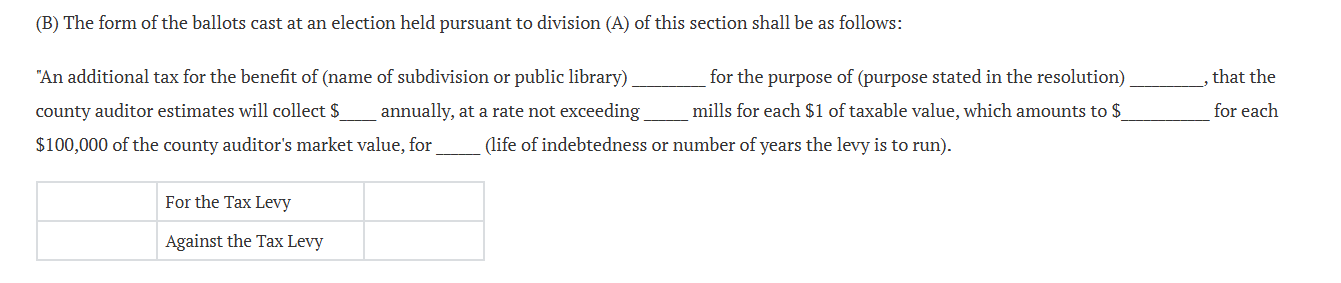
Under state law, schools and local emergency response agencies must state that the levy will equal a specific dollar amount for every $100,000 of the county auditor’s market value. The wording has shifted slightly from previous years — ballots used “appraised value” instead of market value from 2022 through Jan. 1, 2026 — but the meaning remains the same.
The Ohio Department of Taxation defines appraised or market value as the price a property would reasonably sell for. If someone owns a $500,000 home, its market value is $500,000, but taxes apply to $175,000, or 35%.
Sam Benham, spokesperson for the Ohio Legislative Service Commission, said that although the ballot language changed in 2022, it “did not change the fact that real property is still only assessed at 35% of its true value. It only changed the dollar values that are expressed on the ballot language.”
Lawmakers introduced the ballot language update through the 2022 “Enact Ballot Uniformity and Transparency Act,” also known as House Bill 140. Before this law, election notices and ballot language varied slightly but typically displayed the tax rate in mills and referenced $100 of taxable or assessed value.
H.B. 140 now requires levy requests to present the rate based on each $100,000 of appraised or market value. Officials made this change to help voters better understand millage, or the rate used to calculate property taxes in Ohio.
At the time, several county, school, and local officials opposed the change, arguing it did not make taxation clearer. Erich Bittner of the Ohio Association of County Boards of Developmental Disabilities said the organization feared that using appraised value instead of taxable value would create confusion and potentially expose the state to lawsuits.
“The ‘appraised value’ standard in the bill, however, will not take those differences into account, leading to instances where the tax bill suggested in the ballot language may differ significantly from what will ultimately be owed,” Bittner said.
Greene County Auditor David Graham, speaking on behalf of the County Auditors’ Association of Ohio, disagreed. He said the updated ballot language makes it easier for voters to understand how they will be taxed.
“Those who oppose this legislation may argue that disclosing this information may make passing levies more difficult,” Graham said. “They may be right, but if this is truly the people’s government, they should understand how much tax revenue money is needed to provide the services that government provides.”
Regardless of the wording, Ohioans still pay property taxes on 35% of their home’s value. Voters will next weigh in on property taxes and other issues on May 5.











Leave a Reply